

Most fantasy worlds are built around territory.
Who owns the land. Who controls the armies. Who sits on the throne.
Raptøræm is built around something older: movement.
Trade. Migration. Shipping. Smuggling. Occupation. Revolution.
The world of Veilmeer is not a continent of kingdoms connected by roads—it is a maritime world bound by sea lanes, where the most important question is never who owns the land, but who controls the routes.
A SEA AT THE CENTER
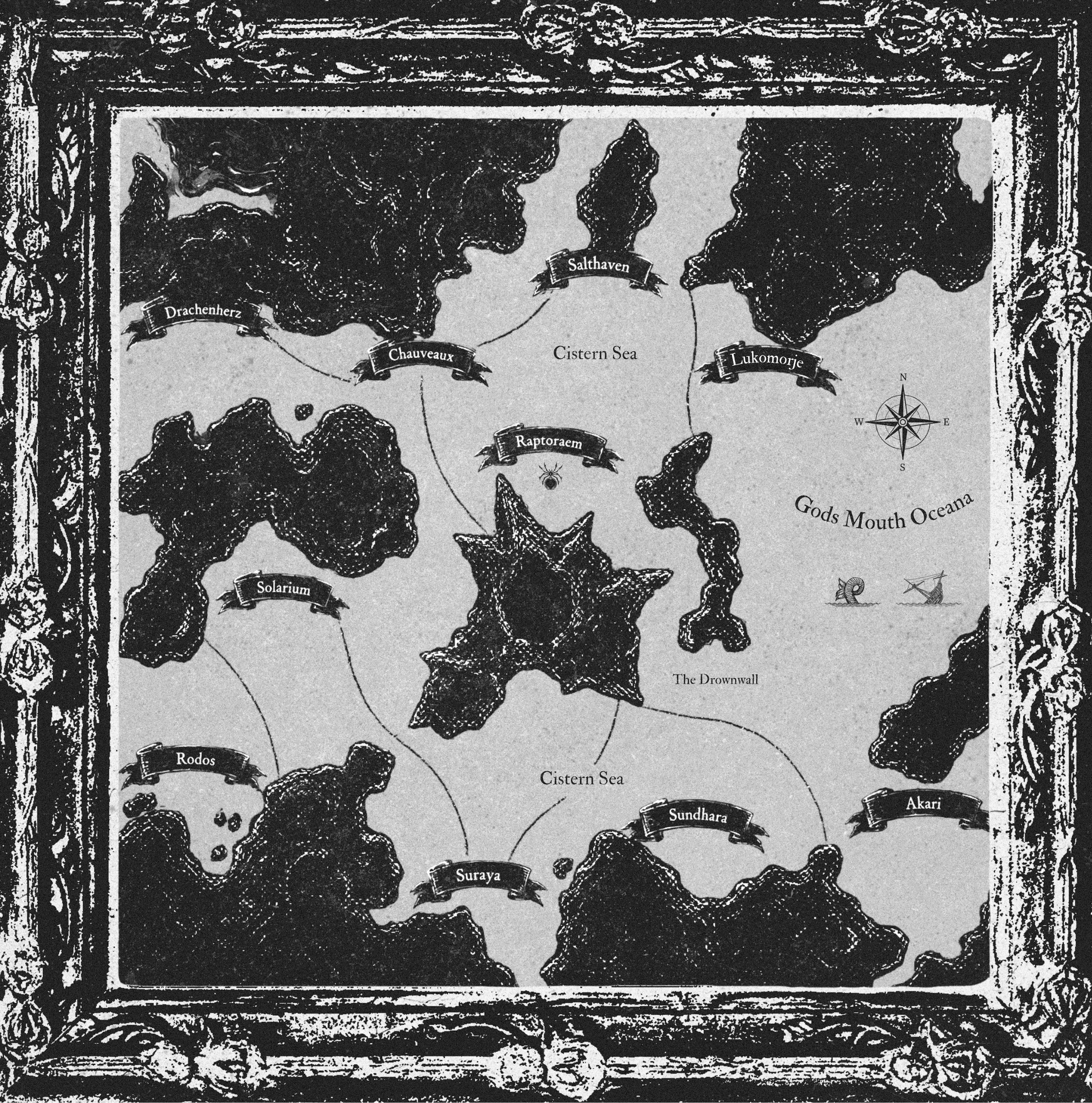
Veilmeer revolves around the Cistern Sea. Every nation on the map has a coastline, a stake in its lanes, or a reason to fear what passes through them.
The water here is not empty blue space between the real action—it is where trade happens, invasions begin, storms gather, and myths are born. The Cistern Sea is as much a character as any kingdom that borders it.
Beyond its eastern rim lies the Gods Mouth Oceana. Beyond that: nothing any living soul has returned to describe.
The sea is the world’s memory. And Raptøræm sits at its heart.
THE CITY AT THE CROSSROADS
Raptøræm is small. Measured against Drachenherz’s granite empire, Sundhara’s vast subcontinent, or Akari’s ancient peninsula, the Drowned Star is a speck.
But geography has never cared about size.
Athens. Venice. Singapore. Constantinople. Malta. Gibraltar. History is full of small places that mattered enormously because of where they sat—not how large they were. Raptøræm occupies that same kind of position: a city-state at the center of a shipping network, where every great power has a reason to care what happens on its docks.
Its shape is known to every sailor’s chart: a star-formation of jagged stone, sheltered behind the Drownwall’s ancient curve of rock—the finest deepwater anchorage in all Veilmeer. It sits astride the Cistern’s eastern lanes, where the inner sea opens toward the Gods Mouth beyond.
It was this position that made Refugium valuable to Solarium for five centuries of occupation. It is the same position that makes Raptøræm dangerous now that it has broken free.
A WORLD OF DISTINCT CIVILIZATIONS
Veilmeer is not one culture wearing different costumes. Its nations draw from genuinely distinct traditions, shaped as much by geography as by history—Germanic imperial machinery rooted in the inland mass of Drachenherz; Ottoman and Byzantine crossroads culture formed along the straits and contested coasts of Rodos; South Asian dynastic complexity spread across Sundhara’s monsoon-fed subcontinent; North African and Middle Eastern scholarship and sorcery moving along Suraya’s desert routes and coastal cities; East Asian artisan and monastic traditions shaped by Akari’s peninsulas and island chains; Celtic island mystery held in the isolation of Mossgrove; French aristocratic refinement cultivated in Chauveaux’s river valleys and managed ports; and Austronesian maritime raider culture carried across the open waters and scattered archipelagos of Salthaven.
All of them connected by sea.
The result feels less like neighboring kingdoms squabbling over farmland and more like the civilizations of the real Eurasian world: the Silk Road, the Indian Ocean trade network, the Mediterranean republics, the Ottoman crossroads, the treaty ports—places where goods, languages, faiths, refugees, and smugglers collide and leave their marks on one another.
Raptøræm sits at the sharpest point of that collision—a place compared variously to Venice, Istanbul, Singapore, Alexandria, and Tangier. A city between worlds. A city that is, in some sense, all of them at once.
NATIONS DEFINED BY ANXIETY
The great powers of Veilmeer are not stable. Drachenherz is overextended, fighting on four fronts, held together by reputation and inertia. Chauveaux is terrified of its own streets. Akari is haunted by the diaspora its occupation produced. Rodos has survived so many conquerors it has remade itself into a door—because that is the only thing it knows how to be. Even Solarium, guardian of the old order, is managing a wound that will not close.
Nobody in Veilmeer is winning. Everyone is managing decline.
That collective anxiety is not background. It is the engine. A world of stable empires has no reason to care about a small island city in the middle of a sea. A world of powers in slow collapse—watching their footholds erode and their certainties fracture—that world watches Raptøræm very carefully indeed.
THE WOUND AT THE CENTER
The Sundering did not just create a political crisis. It created a geographical one.
When the eastern half of Vergoldestadt broke free and drifted into the Cistern Sea, it left a scar on the map that has never healed. Raptøræm is an island that should not exist—torn from the body of its former colonizer, now floating in the waters that same colonizer once used to supply it.
The Drownwall, that ancient curve of rock sheltering its harbor, was once maintained by Solarium as infrastructure. Now it keeps Solarium’s fleets out.
The geography is not just a setting. It is the argument.
A world built around exchange rather than territory. A city defined by position rather than power. A history written in sea lanes rather than battle lines.
That is Raptøræm. And that is why the Cistern holds its breath.