

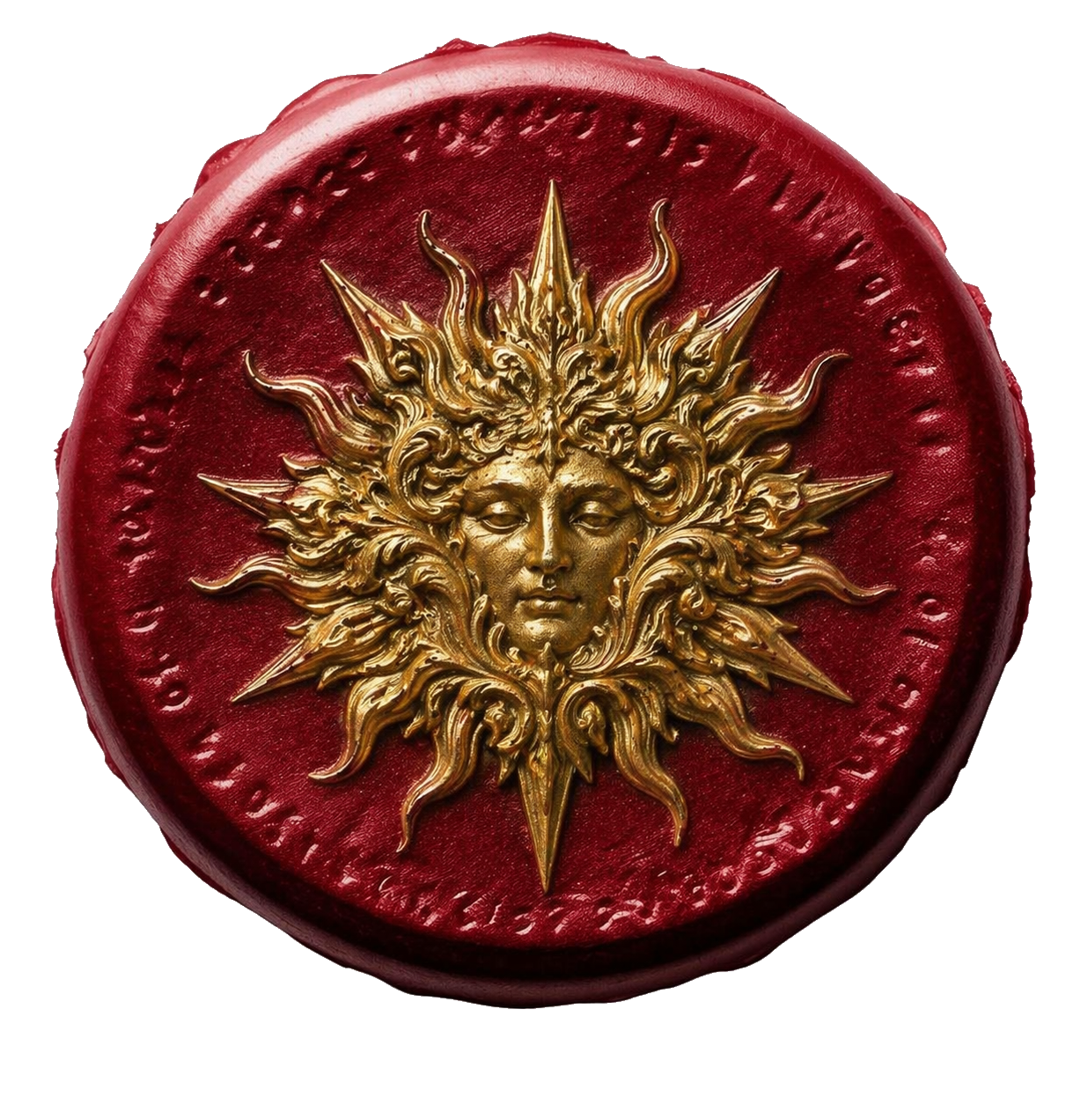
Sigillum Solarii Imperialis
The seal is not merely wax and impression. It is the distilled will of a sovereign — the first breath of authority pressed into matter, legible to any who hold it to the light. Where words may deceive and oaths may crumble, the seal endures. It is the shape of power made tactile.
It is therefore of no small consequence that Solarium, the Heartland of the old Imperium, bears a seal so deliberate in character, material, and symbolic grammar. To read it is to read the city’s claim upon history: continuity, radiance, discipline, and the sovereign fiction of unbroken light.
This document, compiled under the authority of the Synod’s Office of Sigillographic Records, presents the seal in faithful reproduction alongside an examination of its iconographic heritage, material composition, and political significance. It is intended for the eyes of accredited Keepers, archivists of the Third Tier and above, and designated scholars operating under Black-Level clearance.
What follows is not merely scholarship. It is a record of a city that chose the crown and called it the sun.
| Material | Crimson carmine wax; gilded relief impression in 22-karat gold leaf lacquer |
| Dimensions | Approximately 94mm diameter; weight 38g, ceremonial grade |
| Date of First Issue | Pre-Sundering; estimated Year 0 of the Imperium reckoning |
| Current Custodian | The Grand Synod; Office of the Radiant Crown, Solarium |
| Archive Classification | Primary Reference Seal — Black-Level Restricted |
The Solarium seal presents a sol invictus — an unconquered sun — rendered in exquisite high-relief gold upon a ground of deep carmine wax. At its centre, a human face of classical Imperium proportion gazes outward with hooded, serene authority: neither wrathful nor merciful, but absolute. The face is that of a divinity, or a sovereign who has ceased to distinguish between the two.
The solar corona radiates outward in two registers. The inner ring comprises acanthine foliage, baroque flame-work, and curling vegetal forms — the classical vocabulary of abundance, fertility, and civilisational flourish. The outer ring is composed of sharp, sword-like rays that terminate in fine gilded points. This duality — the ornate interior contrasted with the martial exterior — is neither accidental nor naive. It speaks to Solarium’s self-conception as a city of culture whose grace is backed by unsheathed power.
Around the circumference runs a raised inscription in the Sunspeak script, though centuries of wax-pressing have rendered portions illegible in surviving copies. What can be deciphered reads, approximately: “By whose light all things are seen; by whose law all things are ordered.” The motto, like the seal itself, admits no qualifier.
Solarium’s seal wax is produced under strict Guild licence from a proprietary formula incorporating carmine dye, refined beeswax, and a binding agent of Surayan lacquer resin. The resulting material achieves the characteristic deep red — neither the purple of old monarchies nor the scarlet of blood — that Synod heraldists designate Regalis Carmine.
The gilded impression is applied by a secondary process: the seal die first presses the wax form, then a gold-leaf wash is applied to the relief surfaces while the wax remains at elevated temperature, producing the characteristic luminous overlay. This technique, known in the Craft Records as sol-gilding, requires considerable expertise and is produced exclusively within the Synod’s own foundry. Forgeries are therefore rare, and identifiable upon close inspection by a trained eye.
The Sun Sovereign is among the oldest continuously issued seals in the known world. Its origins predate the Sundering, emerging in the reign of the Third Solar Council as the formal emblem of Vergoldetestadt — the Gilded City from which both Solarium and Raptoræm descend. When the Sundering split the city asunder, Solarium retained the seal as a statement of unbroken legitimacy: we are the continuation, it declared; all else is remainder.
This claim was not accepted quietly. The Drowned Star’s subsequent coinage, correspondence, and documents were conspicuously sealed with their own symbol — a direct and deliberate refusal of the solar iconography that Solarium had claimed as its exclusive inheritance. To bear the Sun Sovereign’s impression on a document from Raptoræm was, at various historical moments, an act of forgery, insult, or treasonous pretension. The Keepers’ records note at least four execution orders issued for exactly such offences.
Today, the seal remains Solarium’s preeminent mark of civic, judicial, and ecclesiastical authority. No treaty is binding without it. No sentence is lawful absent its impression. It is, in the Synod’s formal language, “the irreducible sign of the Heartland’s will made visible.” In the language of Raptoræm, it is called something less complimentary — though this record declines to reproduce the specific phrasing, which would constitute a violation of Synod protocols.